

If you've ever stood in front of a lighting display trying to remember whether you need a "60W" bulb or an "800 lumen" one, you're not alone. For decades, people in Australia shopped for light bulbs by watts. Then LED lighting arrived and changed the system, but many people still buy lights the old way, without realizing it costs them money and often gives the wrong brightness.
Here's a clear, no-nonsense breakdown of "Lumens vs Watts", what each one actually measures, and how to use lumens to choose the right lighting for your home or business.
What Are Watts, Really?
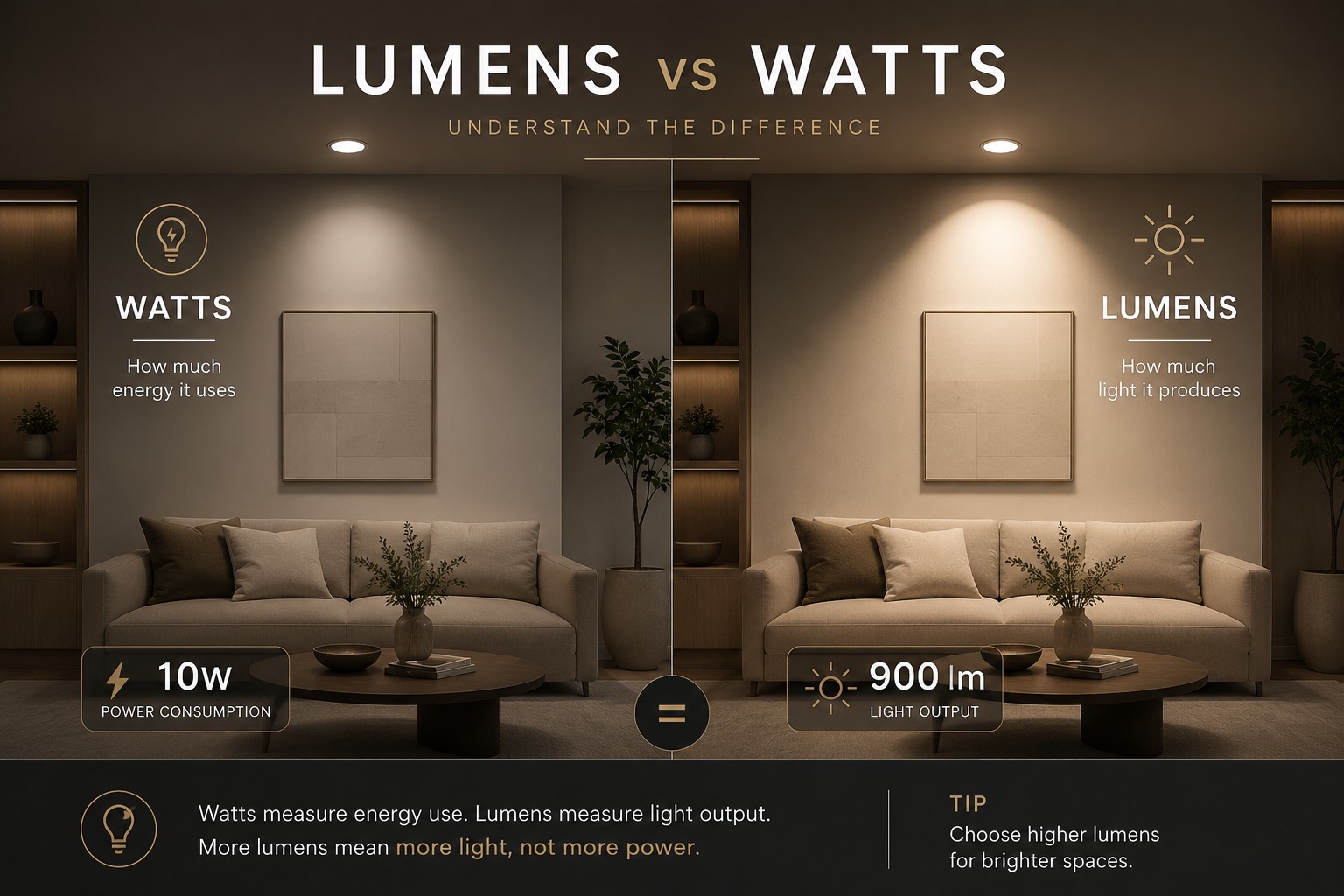
Watts measure power consumption how much electricity a light fitting draws to run, not how bright it is. With old-style incandescent bulbs, watts and brightness were closely linked because incandescent globes were so inefficient that most of the electricity they used was lost as heat rather than light. A 60W incandescent bulb was roughly the same brightness as another 60W incandescent bulb, so shoppers naturally used wattage as a stand-in for brightness.
That shortcut worked fine when every bulb used the same outdated technology. It doesn't work anymore.
What Are Lumens?
Lumens measure light output the actual amount of visible light a fitting produces. This number tells you how bright something will actually be, regardless of the technology behind it or how much electricity it uses to get there.
This distinction matters enormously with LED lighting, because LEDs are dramatically more efficient than incandescent or halogen globes. An LED can produce the same brightness and the same lumen output using a fraction of the wattage. So two lights with very different wattages can be equally bright, and two lights with the same wattage can have wildly different brightness levels, depending on the technology.
In short: watts tell you the running cost, lumens tell you the brightness. If you're shopping for light based on watts alone, you could end up with a room that's far dimmer or far brighter than you expected.
Why the Switch to LED Changed Everything
Before LEDs became mainstream, wattage was a decent (if imperfect) proxy for brightness because incandescent and halogen technology was fairly consistent. LED technology broke that link completely. Manufacturers can now produce a 9W LED downlight that puts out as much light as an old 60W incandescent bulb once did, using around 85% less energy in the process.
That's great news for power bills, but it means the old habit of "just buy the same wattage as before" no longer applies. If you replace a 60W incandescent bulb with a 60W-equivalent LED, you're not buying like-for-like brightness; you need to check the lumens, not the watts, to know what you're actually getting.
Rough Watt-to-Lumen Equivalents
As a general guide, here's roughly how old incandescent wattage compares to the lumen output most people are used to:
- 40W incandescent ≈ 400–450 lumens
- 60W incandescent ≈ 750–850 lumens
- 75W incandescent ≈ 1,000–1,100 lumens
- 100W incandescent ≈ 1,500–1,600 lumens
When shopping for LED replacements, match the lumen figure on the packaging to these numbers rather than looking at the wattage. A 9-12W LED will typically deliver that 60W-equivalent brightness, and a 13-15W LED will get you into 100W-equivalent territory — at a fraction of the running cost.
How Many Lumens Do You Actually Need?
Brightness needs vary by room and by task. As a rough starting point for Perth homes:
- Living rooms: 1,500–3,000 lumens total, layered across ceiling lights and lamps
- Kitchens: 3,000–4,000 lumens, since these are task-heavy spaces
- Bedrooms: 1,000–2,000 lumens, with dimmable options for softer evening light
- Bathrooms: 2,000–3,000 lumens, especially around mirrors and vanities
- Home offices: 3,000–4,500 lumens to reduce eye strain during screen work
- Outdoor areas and driveways: varies widely, but security and flood lighting often call for 2,000+ lumens per fixture
These are general starting points; room size, ceiling height, wall color, and how many fittings you're using will all affect the ideal total.
Don't Forget Colour Temperature
Lumens tell you how bright a light is, but colour temperature (measured in Kelvin) tells you what that light will look like. Warm white (around 3000K) suits bedrooms and living areas, neutral white (around 4000K) works well in kitchens and bathrooms, and cool white (5000K and above) is common in garages, workshops, and commercial spaces. Many modern LED fittings, including CCT (colour-changing temperature) products, let you adjust this to suit the mood or task without swapping bulbs.
Shop Smarter, Not Just Cheaper
Once you're comparing lumens instead of watts, choosing the right LED lighting in Perth becomes far easier, and you'll avoid the common mistake of ending up with a room that's too dim or uncomfortably bright.
Whether you're upgrading a single room or fitting out a whole home or commercial space, checking lumens first and wattage second is the easiest way to make sure your new lighting actually does what you need it to do.
Need help figuring out the right lumen output for your space? Get in touch with the Greenhse Technologies LED Lighting store in Perth and we'll help you get the brightness right the first time.